

How To Find Domain In Set Builder Notation
three.2. Domain and Range
Domain and Range
One of our main goals in mathematics is to model the real world with mathematical functions. In doing and so, information technology is important to keep in mind the limitations of those models we create.
This table shows a relationship betwixt circumference and height of a tree as it grows.
| Circumference, c | i.7 | 2.five | 5.5 | 8.two | 13.7 |
| Height, h | 24.v | 31 | 45.2 | 54.6 | 92.i |
While there is a stiff relationship between the 2, it would certainly be ridiculous to talk about a tree with a circumference of -3 feet, or a pinnacle of 3000 feet. When nosotros identify limitations on the inputs and outputs of a office, we are determining the domain and range of the function.
Domain: The gear up of possible input values to a function
Range: The prepare of possible output values of a function
Using the tree table above, determine a reasonable domain and range.
Nosotros could combine the information provided with our own experiences and reason to approximate the domain and range of the function h = f(c). For the domain, possible values for the input circumference c, it doesn't make sense to take negative values, so c > 0. We could make an educated judge at a maximum reasonable value, or look upward that the maximum circumference measured is near 119 feet. With this information we would say a reasonable domain is 0 < c ≤ 119 feet.
Similarly for the range, it doesn't brand sense to have negative heights, and the maximum height of a tree could exist looked up to be 379 anxiety, so a reasonable range is 0 < h ≤ 379 feet.
When sending a letter through the The states Mail service, the price depends upon the weight of the alphabetic character, as shown in the tabular array below. Determine the domain and range.
| Letters | |
| Weight not Over | Price |
| one ounce | $0.44 |
| 2 ounces | $0.61 |
| 3 ounces | $0.78 |
| 3.5 ounces | $0.95 |
Suppose nosotros notate Weight by due west and Price by p, and set a function named P, where Toll, p is a function of Weight, w. p = P(w).
Since adequate weights are three.5 ounces or less, and negative weights don't make sense, the domain would be 0 < w ≤ 3.5. Technically 0 could be included in the domain, only logically it would mean we are mailing nothing, so it doesn't hurt to get out it out.
Since possible prices are from a limited set of values, nosotros can only define the range of this function by listing the possible values. The range is p = $0.44, $0.61, $0.78, or $0.95.
Notation
In the previous examples, we used inequalities to draw the domain and range of the functions. This is one way to describe intervals of input and output values, merely is not the simply style.
Using inequalities, such every bit 0 < c ≤ 163 , 0 < west ≤ 3.5 , and 0 < h ≤ 379 imply that we are interested in all values betwixt the low and loftier values, including the high values in these examples.
Yet, occasionally nosotros are interested in a specific list of numbers similar the range for the price to transport letters, p = $0.44, $0.61, $0.78, or $0.95. These numbers stand for a set of specific values: {0.44, 0.61, 0.78, 0.95}
Representing values every bit a set, or giving instructions on how a set is built, leads us to another blazon of annotation to depict the domain and range. Suppose we want to describe the values for a variable x that are 10 or greater, merely less than xxx. In inequalities, we would write 10 ≤ x < 30 .
When describing domains and ranges, we sometimes extend this into set up-builder notation, which would look like this: {x | 10 ≤ x < 30}. The curly brackets {} are read as "the set of", and the vertical bar | is read as "such that", and then birthday we would read {x | 10 ≤ ten < 30} every bit "the set up of x-values such that 10 is less than or equal to x and x is less than 30."
When describing ranges in set-builder annotation, we could similarly write something like {f(x) | 0 < f(x) < 100}, or if the output had its own variable, nosotros could utilize information technology. So for our tree elevation instance above, we could write for the range {h | 0 < h ≤ 379}. In ready-architect annotation, if a domain or range is non express, nosotros could write {t | t is a real number} , or {t | t ∈ ℜ}, read as "the ready of t-values such that t is an chemical element of the fix of real numbers.
A more compact alternative to set-architect notation is interval notation, in which intervals of values are referred to by the starting and ending values. Curved parentheses are used for "strictly less than," and square brackets are used for "less than or equal to." Since infinity is not a number, we can't include it in the interval, so we always apply curved parentheses with ∞ and -∞. The table beneath volition help you lot see how inequalities stand for to set-architect notation and interval annotation:
| Inequality | Set Architect Notation | Interval notation |
| 5 < h ≤ 10 | {h | 5 < h ≤ 10} | (5, 10] |
| v ≤ h < ten | {h | 5 ≤ h < 10} | [5, 10) |
| five < h ≤ 10 | {h | 5 < h < 10} | (5, ten) |
| h < x | {h | h < 10} | (-∞, 10) |
| h ≥ 10 | {h | h ≥ ten} | [10, ∞) |
| all existent numbers | {h | h ∈ ℜ} | (-∞, ∞) |
To combine ii intervals together, using inequalities or ready-builder notation we can use the word "or". In interval note, we use the union symbol, ∪ , to combine two unconnected intervals together.
Describe the intervals of values shown on the line graph below using ready builder and interval notations.

To depict the values, x , that lie in the intervals shown above we would say, "x is a existent number greater than or equal to ane and less than or equal to three, or a real number greater than v."
Equally an inequality it is: ane ≤ ten ≤ 3 or x > 5.
In gear up builder notation: {x | 1 ≤ x ≤ three or 10 > 5}.
In interval annotation: [1, 3] ∪ (five, ∞).
Recall when writing or reading interval notation: using a foursquare bracket [ means the offset value is included in the set; using a parenthesis ( means the start value is not included in the set.
Domain and Range from Graphs
We can besides talk well-nigh domain and range based on graphs. Since domain refers to the set of possible input values, the domain of a graph consists of all the input values shown on the graph. Remember that input values are almost ever shown along the horizontal axis of the graph. Too, since range is the prepare of possible output values, the range of a graph we tin can see from the possible values along the vertical axis of the graph.
Exist careful – if the graph continues beyond the window on which we can see the graph, the domain and range might be larger than the values we can run into.
Make up one's mind the domain and range of the graph below:

In the graph above, the input quantity along the horizontal axis appears to be "twelvemonth", which we could notate with the variable y. The output is "thousands of barrels of oil per twenty-four hour period", which we might notate with the variable b, for barrels. The graph would likely continue to the left and right across what is shown, only based on the portion of the graph that is shown to us, we can determine the domain is 1975 ≤ y ≤ 2008 , and the range is approximately 180 ≤ b ≤ 2010 .
In interval notation, the domain would exist [1975, 2008] and the range would be most [180, 2010]. For the range, we have to judge the smallest and largest outputs since they don't fall exactly on the filigree lines.
Remember that, as in the previous example, x and y are not e'er the input and output variables. Using descriptive variables is an important tool to remembering the context of the problem.
Domain and Range from Formulas
Nigh basic formulas tin can be evaluated at an input. Two common restrictions are:
- The square root of negative values is non-real.
- We cannot split up past zero.
Find the domain of each function:
a) 
b) 
Solution
a) Since nosotros cannot take the foursquare root of a negative number, we need the inside of the foursquare root to exist not-negative.
x + 4 ≥ 0 when x ≥ -4.
The domain of f(10) is [-4, ∞).
b) We cannot divide by nothing, and so we demand the denominator to be not-zero.
six – 310 = 0 when 10 = ii, so nosotros must exclude 2 from the domain.
The domain of k(x) is (-∞, 2) ∪ (ii, ∞).
Piecewise Functions
Some functions cannot be described past a single formula.
Piecewise Function: A piecewise office is a function in which the formula used depends upon the domain the input lies in. We notate this concept equally:

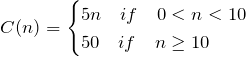
A museum charges $five per person for a guided tour with a group of one to 9 people, or a fixed $50 fee for 10 or more than people in the grouping. Set a function relating the number of people, n, to the cost, C.
To set up this role, 2 different formulas would exist needed. C = 5n would work for due north values under 10, and C = 50 would work for values of n x or greater. Notating this:
A cell phone visitor uses the function below to make up one's mind the cost, C, in dollars for thousand gigabytes of information transfer.
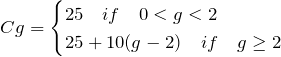
Find the toll of using i.v gigabytes of data, and the cost of using 4 gigabytes of data.
To observe the toll of using i.v gigabytes of information, C(ane.5), we beginning expect to run across which slice of domain our input falls in. Since 1.5 is less than 2, nosotros employ the starting time formula, giving C(ane.five) = $25.
The find the cost of using 4 gigabytes of data, C(4), we see that our input of 4 is greater than ii, then we'll use the second formula. C(four) = 25 + 10(iv – two) = $45.
Sketch a graph of the function 
We can imagine graphing each role, then limiting the graph to the indicated domain. At the endpoints of the domain, we put open circles to betoken where the endpoint is non included, due to a strictly-less-than inequality, and a closed circle where the endpoint is included, due to a less-than-or-equal-to inequality. The beginning and last parts are constant functions, where the output is the same for all inputs. The middle part we might recognize as a line, and could graph by evaluating the function at a couple inputs and connecting the points with a line.

Now that we have each piece individually, we combine them onto the same graph. When the start and second parts meet at x = ane, we tin can imagine the closed dot filling in the open up dot. Since in that location is no break in the graph, there is no need to show the dot.

Do questions
1. The population of a small town in the year 1960 was 100 people. Since then the population has grown to 1400 people reported during the 2010 census. Choose descriptive variables for your input and output and use interval notation to write the domain and range.
2. Given the post-obit interval, write its a) meaning in words, b) set builder notation, and c) interval notation.

3. Given the graph beneath write the domain and range in interval note.

four. At Us College during the 2009-2010 school year, tuition rates for in-country residents were $89.fifty per credit for the commencement ten credits, $33 per credit for credits eleven-18, and for over xviii credits the rate is $73 per credit. Write a piecewise divers part for the full tuition, T, at Us College during 2009-2010 as a function of the number of credits taken, c. Consider a reasonable domain and range.
5. Examine the graph below and indicate the following in both set-builder and interval notations.
a. Domain
b. Range


How To Find Domain In Set Builder Notation,
Source: https://pressbooks.library.ryerson.ca/ohsmath/chapter/3-2-domain-and-range/
Posted by: howardthalle.blogspot.com
0 Response to "How To Find Domain In Set Builder Notation"
Post a Comment